September 22, 2006

Group (4) - Jann, Jessica (loso) and Katrin

QUESTION # 4

(4) Show and explain why the following equation is TRUE or FALSE.

e -ln c = -c


Our group believes this equation is FALSE...


because


as an example, when we sub in the number "2" in for "c"

e -ln c = -c

e -ln(2) = -(2)
0.5 = -2


As you can see... both sides of the equation don't equal each other...


Therefore the equation is FALSE...


In order to make the equation become TRUE, our group came up with two methods.


METHOD 1:

ORIGINAL EQUATION: e-ln c = -c

We changed "-c" to " 1/c " (both negative reciprocals of each other) and we sub in the number "2" in for "c" in order to make both sides equal.

e -ln c = 1/c
e -ln (2) = 1/(2)
0.5=0.5 =] they equal


METHOD 2:

ORIGINAL EQUATION: e -ln c = -c

In this case, we took the negative (-) out of both "ln c
" and "c" and we sub in the number "2" in for "c" in order to make both sides equal.

e ln c = c
e ln (2) = (2)
2=2 =] they equal

So yeah... that's what our group came up with! If anyone has any comments regarding any mistakes we've made, feel free to comment! ; )

Group 5: Crystal, Danny, Lindsay

Group 5 --> Crystal, Danny, Lindsay

5) Prove how the following equation is TRUE or FALSE.

[logb(x)]y = ylogb(x)

We believe that this is false.

If this was to be true, it would have to be:


logb(x)y = ylogb(x)

you need to remove the brackets for it to be equal.

FALSE


[logb(x)]y = ylogb(x)

let b=10, x=2, y=3

[log10(2)]3 = 3log10(2)

[log2/log10]3= 3log10(2)

0.027 = 0.903

this is obviously not correct.

TRUE

logb(x)y = ylogb(x)

ylogb(x) = ylogb(x)

This groups believes that because of the brackets, the equation is not correct and is a common error people can make. Since it's [logb(x)]y, you have to solve first and then put it to the power of 'y'.


If you don't agree with our solution, please post a comment on how you think it should be done. =)


be happy.

GROUP #2 : Ashlynn, Charlotte and Anh.

Is the following equation TRUE or FALSE?
Ln(A+B) = (LnA)(LnB)

Our answer is FALSE. We proved our answer by using an example.

ex: Let A=2 and B=3

Ln(2+3) = (Ln2)(Ln3)
Ln(5) = (Ln2)(Ln3)
(1.6094) = (.6931)(1.0986)
(1.6094) = (.7615)

Both sides of the equation do not equal each other, therefore the original equation is false.


A common error for this particular equation is that people may think they can go from Ln(A)Ln(B) to Ln(AB), but you can't because the logarithm laws do not allow you to do so.

So the correct answer would be:
Ln(AB) = Ln(A) + Ln(B)

September 21, 2006

Scribe Post: Day 10

Hi guys! This is Jann and I'll be your scribe for today.
As usual, we started our class with 3 problems.

Questions:

1. Find the inverse of each of the following:

a) f(x)= (x+3)/3

Solution:

i) Switch the y and the x variables.

y= (x+3)/3
x= (y+3)/3

ii) Solve for y.

3[x=(y+3)/3]3
3x= y+3
3x-3= y
f-1(x)= 3x-3

b) g(x)= ³√x-1

Solution:

y= ³√(x-1)
(x)³= [³√(y-1)]³
x³= y-1
x³+1= y
g-1(x)= x³+1

c) h(x)=1/x
Solution:

y= 1/x
y(x= 1/y)y
xy= 1
y= 1/x

Note: y=x is called an identity function. It means you get back what you started with. Since the inverse of this function is the same as it's original, it's considered to be a special function.

Note: If you feed the inverse of a function to itself, you'll always get "x" as an answer. [f(f-1(x))=x]

2. Given: f(x)= 3x/(x+5)

a) How do you know that "f" has an inverse?

Solution:

The easiest way to know if the function has an inverse is to simply graph it. The graph should look something like this:If this passes the horizontal line test, it means it has an inverse. Technically, it passes the line test.

b) Find the inverse of "f".

Solution:

Note: It was mentioned earlier that if an inverse of a function is fed to its original, the answer will always be "x".

f(f-1(x))= x
f-1(x){3f-1(x)/[f-1(x) +5]= x}f-1(x)
3f-1(x)= xf-1(x) +5x
3f-1(x) - xf-1(x)= 5x
f-1(x)*(3-x)=5x
f-1(x)= 5x/(3-x)

Note: We substituted "f-1(x)" as the unknown variable. After solving for "f-1(x)", we ended up with it's inverse: f-1(x)= 5x/(3-x).

3. f(x)= x^3 + 0.2x

a) Is "f" invertible?

Solution:

Note: Like in #2, we should graph the function to know if it is invertible. The graph should look like this:


The graph of this function is invertible because it passed the horizontal line test.

b) Sketch a graph with Domain [-1.5, 1.5] and Range [-1,1].

Note: To sketch this graph, we must adjust the window setting of the screen. To change the setting...

i) Press [WINDOW]
ii) Set "Xmin" to -1.5 and "Xmax" to 1.5
iii) Set "Ymin" to -1 and "Ymax" to 1.
iv) Finally, press [GRAPH].

You should have something like this:

c) Find f-1(0.45) to 2 decimal places.

Solution:

Note: To find the value of "f-1(x)", we need to trace it in the calculator. But first, we need to change our calculator setting to "Parametric". It describes what happens to x and y seperately.

i) Press [MODE]
ii) Arrow down to "Func" the arrow right to "Par". Press [ENTER]
iii) Press [Y=] then enter X1T= T.
iv) Enter Y1T= T^3 +0.2T
v) Press [GRAPH]

After entering the function, Press [WINDOW]. You'll see "Tmin","Tmax", "Tstep". Change "Tmin" to -1.5 and "Tmax" to 1.5

Note: "Tstep" is the calculation done by the calculator every pixel. f-1(0.45) is an "input", so we want the "output" of the function. If we trace the graph to x= 0.45, y should equal 0.18 to 2 decimal places.

Additional Problem: Find f-1(0.55)

Solution: Simply arrow right 2 times. You should see x=0.55, y=0.27

Lastly, if there is anything that's not explained properly, please give a comment.

I forgot to mention the method to draw the inverse of a function on the graph. Here are the steps:

i)Press [2nd] then [PRGM]
ii)Press [8] that says "DrawInv" then press [ENTER].
iii)The command will appear on the home screen. Press [VARS] then arrow right once then press [1].
iv) Press [Y1] (depends where you entered your function). Press [ENTER]

It should show you the inverse of the function you entered in [Y=].

I would also like to remind everyone that there "might" be a quiz tomorrow or on monday. Be ready.

Thats everything we talked about in class, I think. The next scribe is.... umm.... Christian. (^.^V)

September 20, 2006

Scribe Post: Day 9

Hey everyone, this is Suzanne. We started today’s class off with that quiz everyone had been looking forward to so very much. So I’ll start off by going over some of the methods Mr.K discussed for the first question, where we were asked to state how many roots the function had, and what the largest root was.

Unfortunately I don’t have the exact equation, so these graphs are an approximation. And not the greatest either. I'm no artist :p a) This function had two roots, but when you graph it on your calculator, it appears at first glance to have three roots. There are several ways to determine whether or not there is a root.

Method 1: First off, you can use the zero function on your calculator by pressing 2nd calc, zero. If the calculator comes up with a zero, then there’s a root there. But in this case, an error comes up saying ‘no sign change’. If this happens, then either there is no root, or the root touches the x-axis but does not cross it. This can be seen, for example, with the graph f(x)=x2.

Method 2: So we still need to figure out whether there is a root or not. We can use the zoom-in function on the calculator, closing in on the root until we can clearly see whether it touches the x-axis or not. (I don't know if you can really tell, but I promise you that it's not touching the x-axis in this diagram. Cross my heart.)Method 3: Finally, we can find the minimum. Press 2nd, calc, minimum. The procedure from there is the same as if you were calculating a zero. (First pick a point to the left, then to the right). If the minimum value is greater than zero, then there is definitely no root. I personally think this is the most efficient way to complete the problem.

b) This function was very sneaky… it appears at first to have three roots. However, by looking at the equation we can tell that there are actually 4 roots. The highest exponent is even, so we know that both outer arms of the graph must go in the same direction. In this case, there was a negative sign in front of the function, so we know they point downward. Therefore there must be another root somewhere off to the right. We can find this root two ways.

Method 1: Expand the size of the window until you see the root. Then it is just a case of using the zero function on your calculator.

Method 2: Go to the table by entering 2nd, table and find the zero. Well, in this case it’s a nice prettyful zero at 50, but of course we will not always be that lucky. Just look for where the y-values go from positive to negative, and you will have a good idea where to look for the zero. Then it’s just a case of using method 1 to find your root.

I'm not going to go into the rest of the quiz, since I don't have the questions. After the quiz we started to talk about inverses, which is going to lead into a lesson on logs tomorrow (I think). First of all we discussed that exponents are the inverse of logs. Mr. K said that logs of base 10 and e are the most frequently used, and that after high school they are pretty much the only thing we will see. So here are some of the ideas we went over:

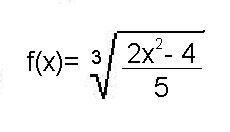
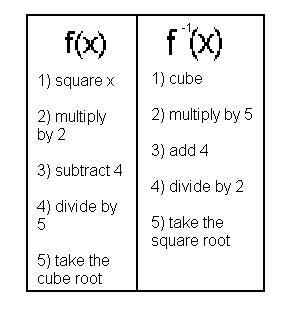
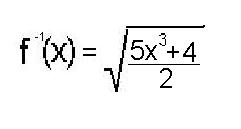
1) Find the inverse of the function:

We went over two ways of doing this.

Method 1: List step-by-step what is happening to x, then go through those steps from last to first, undoing whatever that step did.

and the function we end up with is:


Method 2) Switch x with y in the equation and then isolate y. You'll get the same answer as stated above. Note that this method won’t work on all functions. For example, f(x)= (2x-1)/(x+3) will not work. The reason for this is that 2 things are happening to x at once.

2) We have 2 functions: f(x)=2x+3 and g(x)= ½(x-3). What is f(g(x))?

f(g(x))= 2(1/2(x-3)) +3
= x-3+3
=x

In this case what you put in is what you get out. In other words, these two functions are inverses.

And that’s all I have guys. Stay tuned for tomorrow’s thrilling continuation! And the lucky winner of the ‘next scribe’ competition is…. Jann!

September 19, 2006

Scribe Post: Day 8

Hey kids, it's Loso and I was today's class scribe. Today we were given three questions to do, to follow up on what we learned yesterday [technically speaking, it's what you all learned yesterday because I wasn't in class yesterday, SORRY!].

QUESTIONS:

1. Dave invests $100 at 8% interest per year. How much does Dave have after 6 years if the interest is compounded;

a) annually
b) quarterly
c) continuously

2. The population of New Hampshire was 1 million in 1990. It doubles every 25 years. What is it today?

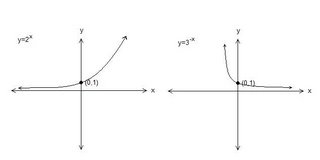
3. Describe all the features and properties of the graphs of:

a) y-2x
b) y=3-x

SOLUTIONS:

1. a) Since we're given a sufficient amount of information, we can use the A=P(1+r/n)tn formula. I'm pretty sure you all know how to plug in the information, but just for every one's sake, let's make sure.

A is what we're looking for.
Our principle amount is $100 [P].
1 is taking 100% of what we already have and then adding it with the rate of interest.
Our rate of interest is 8%, and is 0.08 when written as a decimal [r].
6 is the amount of time we're looking at. [t]
n is the number of times we compound a year. In this case, we're compounding once every year.

A=P(1+r/n)tn
A=100[1+(0.08/1)](6)(1)
A=100(1.08)6

We were able to leave it at that for today.

b) We use the same formula, with the exception that we're compounding 4 times a year, instead of once a year.

A=P(1+r/n)tn
A=100[1+(0.08/4)](6)(4)
A=100(1.02)24

c)For c, we use A=Pert

A=Pert
A=100e(0.08)(6)
A=100e(0.48)

2. For this question, we use A=Ao(M)t/p

A=Ao(M)t/p
A=1,000,000(2)15/25

Umm, I kind of missed the answer. He was going through it pretty quickly. Hopefully I did that right.

3.


These are what the graphs look like.

y=2x

-increasing function (or grows exponentially)
-asymptote is y=0
-DOMAIN (-∞, ∞)
-RANGE (0, ∞)
-y int. y=1
-no roots
-concaves up


y=3-x


-decreasing function (or exponential decay)
-asymptote is y=0
-DOMAIN (-∞, ∞)
-RANGE (0, ∞)
-y int. y=1
-no roots
-concaves up


Everything in purple is what is similar between both functions.


We then discussed how to describe what an inverse was.

VERBALLY: An inverse of a function is a function that undoes what the parent function does. You can also say, the inputs become outputs, and the outputs become inputs

He brought up the baby play and parent clean up example. I think we're all pretty clear of what the point of that was.

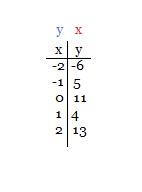
NUMERICALLY: This was the example we were given, basically showing how the y values become x values, and the x values become y values.

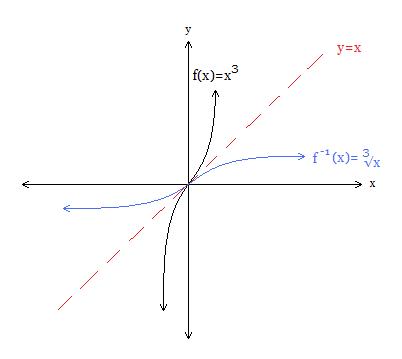
GRAPHICALLY:
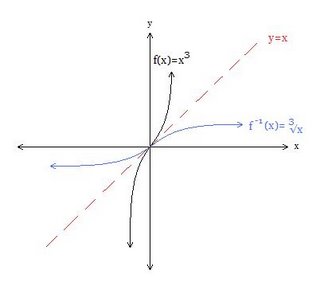
Yeah, I know the lines look wrong, but it's the best I can do right now so bear with me. Near the end of the class, there was some discussion about one to one functions, which at this time is quite vague to me. It's late and my brain needs rest. Our homework is exercise 1.6, all odd questions including 10,18,28 and 30.

For the next scribe, I choose Suzanne. Have fun with that. =)

September 18, 2006

Scribe post: Day 7

ScribeBadge11Hey everyone my name is Ashlynn and I will be your scribbler for today =D. Sorry if I was late on my scribe, I lost my first version and I had to start all over, and it frustrated me a bit. But it's okay now =) . Today's class began with a talk about which scribes belong in the Hall of Fame. Well class began with these questions:

1) If the graph of a function of the form y = Cert passes through the points (0,3) and (2,7), determine the constants C and r.

I started by plugging the value (0,3) into the equation y = Cert;
* The input value is 0, which is t, and the output value is 3, which is y. So I just substituted them into the equation*
3 = Cer0


Anything raised to a 0 equals 1 so er0 = 1.

3 = C(1)

therefore;

C=3

To solve for r, we start by using C = 3 and the points (2,7) into the equation.

7 = 3er2

7/3 = er2

Take the natural log of both sides

ln (7/3) = 2r lne

We know that ln e = 1. ln e = 1 because ln e=loge e ( I don't know how to make subscripts so bare with me =) ) Base e raised to the power of e is one. This is a rule that applies all the time. I understand what this is about, but I am having difficulty explaining it, so please be free to leave a comment.
ex) log5 5=X
5x = 5
5x = 51

Now back to our question;

ln(7/3) = 2r
(1/2) ln(7/3) = r

so, r = .4236489302 , but we can round it off to four decimal places

r = .4236

2) Six months after some laboratory rats were delivered to a new research lab, there were 786 rats present. Nine months after the original delivery there were 1720 rats. Assuming exponential growth for the rat population, how many were in the original delivery?

The equation we use is P=P o(model)t

We know,
P6 = 786 t = 6
P9 = 1720 t = 9
P0 = ?

change in t = 9-6
= 3

We let Po = 786 then t=3. Plug these values into the equation P=Po(model)t

1720 = 786 (model)3

1720/786 = (model)3

Now we use natural log because it deals with population. Populations grow continuously, and that is why we use base e.

ln(1720/786) = 3 ln(model)
(1/3) ln(1720/786) = ln(model)

* *remember when using your calculator to find the answer remember to store your answer*
Sto --> , Aplha A

ln(model) = 0.2610409258 , we can round it to 4 decimal places.

model = e.2610

Our equation is P = 786e.2610t

Okay now we found our model now we have to find the original value. There are 2 methods.

Method 1:

P = 786e.2610t , but we are looking for six months before so t = -6

P-6 = 786 e.2610(-6)

P-6 = 164

Method 2:

Let P6 = 786

786 = Poe.2610(6)

786/e.2610(6) = Po

164 = Po

Homework for tonight is 1.5 in the textbook, odd numbered questions, and to sign up for an account on the websites Mr. K provided in the previous post.

This was pretty much what we did today. I hope my work was clear and easy to understand. Please be free to make any corrections if something is unclear. I'll be happy ot fix it. The next person I pick for Scribe is Loso.