September 18, 2006

Get Your Tools Ready


As we discussed in class today, over the course of the semester we'll be publishing work to the blog and working collaboratively in our learning. We'll all need to use word processors and spreadsheets and other software. In today's connected learning enviroment we can all use the same tools, for free, any time anywhere. You all have to sign up for the following free accounts:


I don't know which one is the best. Try them out and let me know which you prefer, and why, as you use them over the course of the semester. Some other free online tools you might like to use. You must sign up for the four tools above. These ones are optional:

  • lazybase.com (Lazybase allows anyone to design, create and share a database of whatever they like.)

  • thumbstacks.com (Thumbstacks.com is a site for making and sharing presentations on the web.)

  • empressr.com (Empressr is a new Ajax/Flash-based web application that lets you create, share and store presentations online.)

September 15, 2006

Scribe Post: Day 6

ScribeBadge11Okay, I'm the scribe for today, Manny. So for today's class we started by touching up on our homework (homework lab1). It was nothing too difficult (things we did in pre-cal), but Mr.K wanted us to be absolutely correct and KNOW IT IS! He told us a story about an honour role engineer scoring above 90's in school, and getting a job to give a report on soil where a building will be built. Well to make a short story shorter... he gets the report done, and gives it to the boss in charge and the engineer asks "is it right?" ... Uh, thats why YOU were hired! And that was the story.

After that we did these two following word problems, with the solutions:

1) The half-life of a toxic substance is 11 250 years.

a) If 153 g of the substance is present now, write a formula that gives the amount as a function of time, t years from now A(t).
In this problem, lots of information is given. We have the intial value, the multiplication factor, and the period it takes to get to the multiplication factor. So we would look at this equation

A = Ao (M) t / p
where...
A is the final value
Ao is the intial or original value
M is the multiplication factor
t is the time
p is the period

And now we can just plug in the values. Leaving you with the equation...
A(t) = 153(1/2) t /11 250

b) When will only 0.1 g of the substance remain?

We use the equation found in a) above and just plug in the values to look like...

0.1 = 153(1/2) t /11 250

and now we solve for t. To do this, we first need to isolate t as much as possible (it looks better and makes it easier to handle), making it look like this...

0.1/153 = (1/2) t /11 250

so to make it easier to deal with the exponent we would use logarithms or natural logs (base "e"). In this example I'll be using the natural logs just because it's one less letter to type, just like the words of Mr.K. So therefore it'd look like this..

ln 0.1/153 = ln (1/2) t /11 250
ln 0.1/153 = t/11 250 ln(1/2)
(ln 0.1/153)/(ln (1/2)) = t /11 250
11 250 [(ln 0.1/153)/(ln (1/2))] = t

then you're left with this as your exact answer...
t = 11 250 [(ln 0.1/153)/(ln(1/2))] years

REMEMBER: A logarithm is an exponent!

2) In 1951 the population of India was 357 million people. By 1981 it had grown to 684 million. If the population is growing exponentially, what is the population of India today? - i.e. this month

In the problem, it only states two pieces of information. The population in two different years. When little information is given in continuous growth problems, we would use this equation..

P(t) = Po(model)t

From the data, we can let 1951 be 0, so let t=0 in 1951
and since 1981 is 30 years later than 1951, let t=30 in 1981
so now we can say Po = 357 million and P30 = 684 million.

The only piece of information we're missing is the model in which it grows at. To solve for it, plug in the values, making our equation look like this..
683 = 357 (model)30 isolate,
683/357 = (model)30

then now we have a choice of using the logs or natural logs, or we can just raise both sides to the exponent of (1/30), like this
[683/357] 1/30 = [(model)30] 1/30 and so now our

(model) = [683/357] 1/30 and you can just plug in this value into the equation.


There's all sorts of ways of tackling a problem, you just gotta find the one that's more suitable for you. For me its the natural log because, on the exponent on base "e", it gives you the growth rate as a percent already. So we would use the "pert" formula. For example... (continuing from the isolation above)
683/357 = (model)30
ln 683/357 = ln (model)30
ln 683/357 = 30 ln (model)
[ln 683/357] / 30 = ln (model)
(model) = 0.0217 (rounded to 4 decimal places)

0.0217 happens to be the rate of growth, so in percent it would be 2.17%.

So now using base "e" as our (model), we plug in the values. And since it asked for the population in India today, that will be our time. [ 2006 - 1951 = 55 years + .75 because of september is 3/4 of the year. ]

P = 357(e r t )
P = 357(e (0.0217) (55.75) )

P = 1196.9247 million people (rounded to 4 decimal places)


And that was the end of our day! My brain is fried right now, it's like late! I got home from work past 12 =(. My sleeping habits always get ruined over the weekends, sigh...

Homework in our textbook on 1.4 all odd questions + 6, 12, and 14.

So anyway! I hope I was clear and concise about everything. I tried adding in some useful annotations for each step. If things are unclear, comment me and i'll fix it asap. Now, it's bedtime for me... the next scribe will be ashlynn just because you're first alphabetically =).

Good Stuff.

September 14, 2006

Scribe Post: Day 5

Sup, it's DANNY. I'll be your scriber for today!

I apologize if this scribe may have came a little late for some people. I had work after school and only got back just a while ago....I can still feel the pain in my legs =P So if some of you don't see this tonight I'm very sorry.


First, I'd like to say I'm terribly bad at making things look very CrEaTiVe or colourful when I'm actually TRYING to do that instead of just DOING it. Graphics and graphs on the computer aren't my cup of tea either, so PLEASE bare with me. =D


We started things off in class by talking about WIKIS. They're basically websites that are similar to blogs. The only difference is you could change and delete anything you want, including other people's posts. Luckily, if someone were to come by and say delete everything and put down, in the words of Mr.K, "this sucks, this sucks, this sucks", there is a button labelled "history". After you press that button, it shows you the history of the post and what was on it before this PERSON decided to graffiti it. There you can choose "revert to this version" to restore the post back to it's rightful state. Our SCRIBE POST HALL OF FAME is a wiki (http://thescribepost.pbwiki.com/).


To continue on with this theme, Mr.K talked about Linger's AMAZINGLY AWESOME HALL OF FAME WORTHY scribe. He mentioned how Lindsay (and now me) thought Linger's scribe should be in the HOF. If that's the case however and you do want Linger's scribe to be in the HOF (and you should, have you seen that thing???) then you create either a comment or a post?? I can't quite remember, but:

  • has to include scriber's name

  • the post title

  • the subject reviewed

  • a reason why the scribe should be in the HOF and,

  • your name.

So, the talking continued (that's right, one of those days =P). Mr.K talked about this conference he was apart of that was taking part in Boston I believed? But he was talking with an english teacher who taught in England and South Africa through the Internet and computers I believe. His student's did blogs too and they were thinking of arranging a live event online like a chat or net phone.

After that we worked on Problem 3 from yesterday. For those who choose not to scroll down to see that problem and for me to make this scribe look just a little bit longer, I'll put it up:

Actual World Population Data:
FIND THE MISSING VALUE
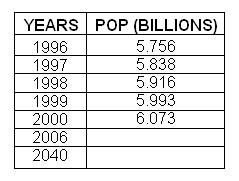

Now, the steps to finding the answers:

  1. Make a list of the data in your calculator by going [STAT] [1] [ENTER]. Now be careful what you use in your calculator for the years. If you were to use say 0 or 1 instead of 1996 you have to have t= 0 in 1996. But for the class we just used 1996 to start the list.

  2. Then [2ND] [Y=] to make sure your plots are turned on and make sure you're using the right list.

  3. Then [ZOOM] [ZOOM STAT], this gives you you're view of the data in plots.

  4. Now we go to [STAT] [right arrow] and choose one (LinReg(ax+b), QuadReg, CubicReg, ExpReg).
  5. The class as a whole tried ExpReg so, [STAT] [right arrow] [0] then [L1], [L2], [VARS] [right arrow] [1] [Y1]

  6. Then take a look at the graph [GRAPH] and it gives you a pretty close graph.
  7. Then we tried LinReg, so basically do everything you did in steps 5 and 6 except you choose LinReg instead of ExpReg. We found it was closer then ExpReg, however here is why it cannot be LinReg. Linear graphs are straight lines while ExpReg are curved lines. This data only shows a small portion of the graph. So even if LinReg seems more accurate it really isn't because it's only showing the accuracy of that ONE SMALL PART. To better understand this I made a little graph
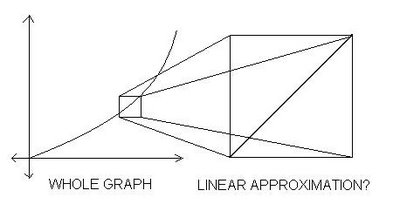
When all is said and done, you use the function that was given to you through the whole steps through 1-6 to find the values, [VARS] [right arrow] [1] [Y1]. Then with Y1 on your calculator's home screen enter (2006) and it should give you a value of 6.5803. If you enter (2040) it should give you a value of 10.3577. The values that Mr.K got from the website where he got the other values do not match the ones we found. That's because it's WAYYYYY too hard to figure out exactly the population of the world in such a FARRRRR period of time. NOTE: IF ANYONE GOT THOSE VALUES DOWN THAT WERE FROM THE SITE, PLEASE LEAVE A COMMENT, THAT'S IF YOU GUYS SEE THIS BEFORE SCHOOL TOMORROW =S.


After spending all that time on that one problem, Mr.K set up the class in four groups of four. He gave us a Lab to do on Exponential Functions. It consisted of 6 problems we had to answer. Here is the actually sheet given to me via e-mail from Mr.K himself (thank you soo much!)..........OKAY! Never mind, I can't give you guys a clear enough picture of it so unfortunately it won't come up. I told you I'm no good at this. It doesn't matter though, you guys all had a chance to see the sheet in class and I won't post of the solutions because that's the classes homework. My group was Manny, Mark, Linger, and myself. Our post of our solutions are already up and that's awesome. Linger did a great job and deserves all the recognition for it. DON'T FORGET TO POST COMMENTS ON EACH OF THE GROUPS POSTS, IT'S PART OF THE HOMEWORK!


Well, that's all I managed to remember or jot down from the class, I hope it's reasonably okay for you guys and doesn't seem to boring (I know it's boring =S), not a bunch of grammar errors an is understandable, that's the most important thing for me. As for the next scribe let me see......hmmm......I'll pick Manny, he's SMART S-M-R-T =D

Remember, there's better things to do then to worry about life!

Danny

Exponential Functions Lab

Group members: Lindsay, Christian, Jann, Suzanne.

Similarities: If either a linear or exponential function is increasing or decreasing, they do so across the entire domain. Neither will begin as an increasing function and suddenly begin to decrease.

Differences:

a) In a linear equation, for every equal change in input, there is an equal change in output (in other words, a line has a constant slope). The outputs of an exponential function do not change at the same rate, but instead increase by a factor of x.

b) The highest exponent in a linear function is 1.

c) Exponential functions have an asymptote at y = 0.

d) Exponential functions always pass through the point (0,1), while linear functions don’t have to.

2. a) f(x) = 3∙4^x
f(0) = 3∙4^0
f(0) = 3

b) This function has a growth factor of 4.

3. f(x) = a^x
f(1) = a^1 , f(1) = 6

therefore:
a^1 = 6
a = 6

4. The function in the graph is decreasing, therefore a<1 according to the background information provided for the lab.

5. f(x) = 2∙5^x

6. The bacteria doubles every six hours, which amounts to a total of 4 times per day. So the number of bacteria is increased by 2^4, or 16, times per day. This exponential function can be described using the equation f(x)= b ∙ 2^x, where b is the initial # of bacteria, and time per 6 hours is x.

Sorry this is being posted rather late, guys. Oh, and Lindsay says:
varsity girls have a tournament friday and saturday, home court..... support marooonnnns!

In-Class Lab

Alright, so in our group we had Charlotte, Crystal, Ashlynn and myself, Loso. Keep in mind that we had a limited time to brain storm so we might've been missing a few facts, oh, and we didn't get a chance to discuss questions 4, 5 or 6. I guess we felt a little rushed.

QUESTION 1:

An exponential function and a linear function both grow in some way; either negatively or postively by some variable.

The difference between an exponential function and a linear function is that a linear function is a constant growth that forms a line, whereas an exponential function is affected by an exponent, creating a curve when graphed.

QUESTION 2:

The y-intercept would be 3 and the growth factor would be 4.

QUESTION 3:

Let f(x) = ax such that f(1) = 6

f(1)=61 which is the same as f(1)=6.

When using 1 as an exponent to the given problem, we know that whatever the end result is, that is what the variable a will be. [ i.e. Given f(x)=ax let x=1, such that f(1)=190, we can say that a is 190. ]

And that's all we got. Sorry Mr. K that we couldn't do more. We'll do better next time? Of course we will.

Danny, Manny, Mark, Linger

In this lab, our group members consisted of Danny, Manny, Mark and myself. Danny has work and he's today's scribe so make sure to check out his post. Manny is volunteering, and Mark is at the football game, hopefully we win this one. Anyway, that leaves me to post up the answers we came up with in class. Hope you enjoy it =)

1) Similarities:
- Both functions have variables.
- Both functions have inputs.
- Both functions have outputs.
Differences:
- The graph of a linear functions produces a straight line, and the graph of an exponential function produces a curve.
- The graph of an exponential function has an asymptote, while the graph of a linear function doesn't.
- The basic exponential function has a y-int at (0,1)
- Linear functions have no exponents.

2) The y-int is 3 and the growth factor is 4.

3)

4) a is less than 1, because the graph shows an exponential decay.

5) f(x)=2 (5^x)

6) Explanation;
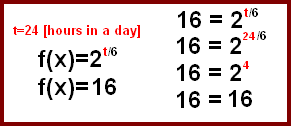
There are 24 hours in a day. We came up with the equation f(x)=2^(t/6) because the questions states that the bacteria doubles every 6 hours... therefore the growth factor is 2, and t/6 is the exponent. The question also states that the equation we came up with is equivalent to a sixteen fold increase, so we also let that equal f(x). We plugged in the values, and found that they equal each other.

The Scribe List

This is The Scribe List. Every possible scribe in our class is listed here. This list will be updated every day. If you see someone's name crossed off on this list then you CANNOT choose them as the scribe for the next class.

This post can be quickly accesed from the [Links] list over there on the right hand sidebar. Check here before you choose a scribe for tomorrow's class when it is your turn to do so.

Don't forget to LABEL your posts!
Go back and fix them if you have to.


Cycle 8

crystal
linger
katrin
Suzanne

char__lene * Pick Me!
christian * Pick Me!
lindsay

Jann
ashlynn
Manny
M-A-R-K